In 2026, the definition of a ‘career’ has shifted from a stable 9-to-5 job to a dynamic survival game where AI and automation are rewriting every traditional rule. Sandeep Maheshwari famously said, ‘The biggest disease is worrying about what people think’ (Sabse bada rog, kya kahenge log)—but in today’s digital era, the actual biggest disease is the fear of change. If you are still relying on skills that worked five years ago, you are rapidly falling behind.
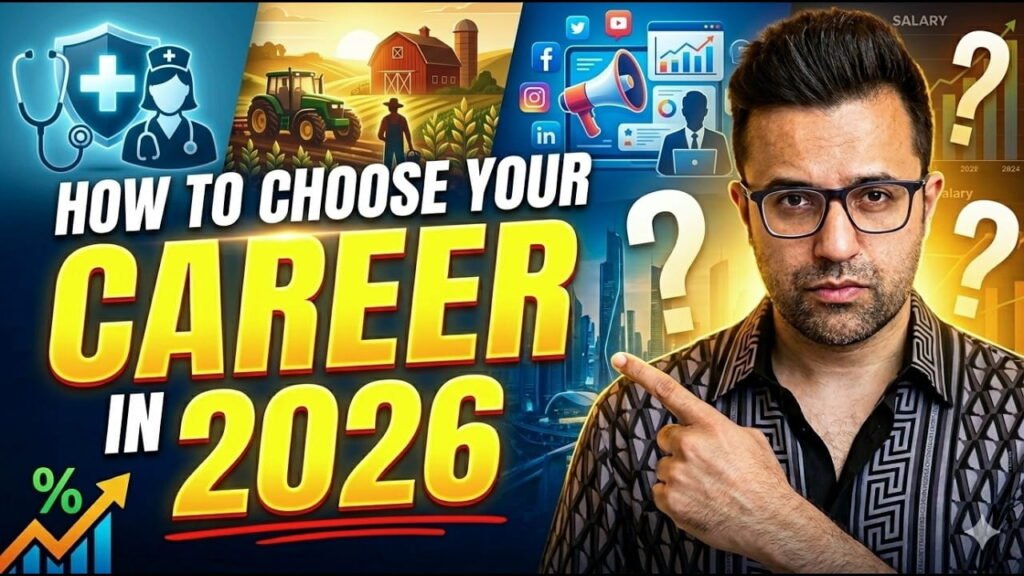
True financial stability is no longer just a reward for hard work; it is the result of taking ‘Smart Risks’ and maintaining a ‘Right Mindset.’ In this comprehensive blueprint, we merge Sandeep Maheshwari’s timeless philosophies with the cutting-edge digital tools of 2026. This guide is designed to help you future-proof your career and achieve that ultimate level of financial freedom where money works for you, not the other way around.
Navigating the Unpredictable Future of 2026
The global economy of 2026 is no longer following the old rules. With rising inflation, unpredictable geopolitical shifts, and the rapid evolution of technology, the traditional career paths we once trusted are facing a massive reality check. During a recent high-impact session, Sandeep Maheshwari dropped a strategic bombshell: “Success in 2026 isn’t about working hard; it’s about choosing the right wind to fly with.”
If you feel like your income is stagnant while your expenses are skyrocketing, you aren’t alone. We are entering a phase where “Discretionary Spending” is shrinking, and only those who position themselves in “Essential Sectors” will thrive. This guide isn’t just about motivation; it is a deep-dive blueprint into understanding market forces, avoiding financial bubbles, and mastering the one skill that remains recession-proof: Strategic Distribution.
Watch: How to Future-Proof Your Career & Finances by 2026
Strategic Masterclass Summary:
- Global Financial Crisis: Inflation will skyrocket by 2026, while salary growth stagnates. Prepare for a massive shrinking of global spending power.
- “Headwind” Industries: Avoid discretionary sectors like restaurants and luxury travel. These faces high failure rates (>90%) during economic downturns.
- “Tailwind” Opportunities: Focus on non-discretionary sectors (essentials) like Healthcare, Agriculture, and Education. These remain stable because they are needs, not wants.
- Distribution is King: In 2026, the real money is not in “Manufacturing” (Production), but in “Distribution” and “Marketing.” Control the supply chain of essentials to control the power.
- The Real Estate Bubble Warning: Sandeep sir warns that 2026 property prices are a speculative bubble driven by FOMO, not intrinsic value. Be extremely cautious about investing.
- The Ultimate Master Skill: To become recession-proof, you must master **Marketing and Sales.** Regardless of your degree, the ability to build a brand and “sell” a solution will be the highest-paid skill of 2026.
10+Point Blueprint
## Section 1: Understanding the 2026 Economic Outlook (The Great Reality Check)
In 2026, we are witnessing a global shift where energy prices and inflation are dictating the survival of businesses. Sandeep Maheshwari points out that while expenses for the average household are increasing at an alarming rate, income levels are struggling to keep pace. This creates a “Virtuous Cycle of Recession,” where companies lay off employees to cut costs, leading to even lower consumer spending.
The first step to future-proofing your career is to stop looking at the past and start analyzing the Macro Environment. Are you in an industry that people can live without, or are you in an industry that is a fundamental necessity? In an era of high inflation, people will cut back on luxury dining and travel long before they cut back on healthcare or basic food. Understanding this shift is the difference between struggling in a “Headwind” and soaring in a “Tailwind.”
Section 2: Discretionary vs. Non-Discretionary: Identifying Recession-Proof Sectors
To survive the financial shifts of 2026, you must understand where people will spend their last rupee. Economically, spending is divided into two categories: Discretionary and Non-Discretionary. Non-Discretionary spending involves essentials like food, basic clothing, healthcare, and education. No matter how high inflation goes, people cannot stop eating or seeking medical help. On the other hand, Discretionary spending covers “wants” rather than “needs”—think of luxury vacations, high-end gadgets, or frequent dining at premium restaurants. In a crisis, discretionary spending is the first thing people cut. If your career or business is built on luxury or “optional” services, you are standing on shaky ground. Aligning yourself with non-discretionary sectors is the safest way to ensure a stable income during a global downturn.
Section 3: The Headwind Strategy: Why You Should Avoid High-Risk Ventures
Many young entrepreneurs in 2026 are tempted to open “aesthetic” cafes or restaurants because they look successful from the outside. However, Sandeep Maheshwari warns that this is a classic “Headwind” industry. A headwind means the environment is working against you.
Restaurants have some of the highest failure rates globally—over 90% shut down within the first year. When you combine high competition with rising costs of raw materials (due to oil and energy inflation) and a shrinking consumer budget, you are swimming against a very strong tide. Even if you work incredibly hard, the external factors—like high rents and low margins—make success a game of extreme luck. Before starting any venture, ask yourself: “Am I pushing a rock uphill, or is the environment helping me move forward?”
Section 4: The Tailwind Advantage: How to Spot Growth Opportunities
A “Tailwind” is when the economic environment, government policies, and global trends are all pushing an industry forward. In 2026, the strongest tailwinds are in sectors that solve fundamental problems created by the crisis.
For instance, while a luxury restaurant might be struggling, a business that provides Affordable Nutrition or Medical Distribution will be soaring. A tailwind doesn’t guarantee you will become a billionaire overnight, but it does mean that even with moderate effort, your chances of success and growth are significantly higher. The goal is to identify industries where the “wind is at your back,” allowing you to scale faster with less resistance.
Section 5: Agriculture 2.0: Moving from Production to Smart Distribution
Agriculture is the ultimate non-discretionary sector—people will always need to eat. However, Sandeep Maheshwari highlights a critical mistake: most people think Agriculture only means “Farming” (Production). In 2026, the real profit isn’t in growing the crop; it’s in Distribution. The biggest problem farmers face is the lack of infrastructure, causing goods to spoil before reaching the city. If you can create a bridge—such as temperature-controlled logistics or a direct-to-market supply chain—you solve a massive problem. Instead of being the one who struggles with the soil, become the “Connecting Link” that ensures quality produce reaches the right buyer at the right price. In a crisis, the person who controls the Supply Chain of essentials is the one who holds the power.
Section 6: The Medical Tourism Boom: A Global Opportunity for 2026
As global inflation hits Western countries, healthcare there is becoming unaffordable. This creates a massive “Tailwind” for Medical Tourism in India. Sandeep sir points out that India offers world-class medical facilities at a fraction of the cost.
However, there is a “Information Gap.” Many international patients don’t know which Indian hospital is best for their specific needs. By creating a specialized platform or a “Medical Consulting Agency” that uses SEO and AI to rank globally, you can connect these international patients with Indian healthcare providers. This is a classic example of Middleman Arbitrage—you don’t need to build a 100-crore hospital; you just need to own the “Digital Entry Point” where the demand meets the supply.
Section 7: Marketing & Sales: The #1 Recession-Proof Skill
When asked about his own success, Sandeep Maheshwari shared a profound secret: it wasn’t just his photography skill that made him a leader; it was his mastery of Marketing and Sales. In 2026, you can have the best product in the world, but if you don’t know how to “sell” or “position” it, you will fail.
Marketing is the ability to understand human psychology and bridge the gap between a problem and a solution. Whether you are an engineer, a CA, or a content creator, you cannot take marketing for granted. In a shrinking economy, companies are desperate for people who can bring in revenue. If you know how to market, you are never “unemployed.” You can take anyone’s product, find the right audience, and earn a commission. Marketing is the master key to the 2026 digital economy.
Section 8: The Real Estate Bubble: Why 2026 is a Year for Caution
One of the most controversial yet vital points Sandeep Maheshwari raised is the current state of the Real Estate market. Many people are rushing to buy property out of FOMO (Fear Of Missing Out) because they see prices doubling every two years. However, in 2026, this has the classic characteristics of a Speculative Bubble.
A bubble happens when the price of an asset is driven by “investors” looking to sell to a “greater fool” at a higher price, rather than the asset’s intrinsic value or utility. With monthly EMIs for a basic apartment reaching ₹1.5 – ₹2 Lakhs, there are very few “real users” who can actually afford to buy these properties. Sandeep sir warns that when the global crisis hits its peak, these non-essential, overpriced assets are the first to crash. If you are investing purely for price appreciation without understanding the demand-supply gap, you are taking a massive risk.
Section 9: Smart Money vs. Dumb Money: Investing Based on Data
The difference between a “Smart Investor” and a “Dumb Investor” is emotional control. Dumb Money follows the “Gut Feel”—buying when everyone is celebrating and selling in a panic when prices drop. They focus on short-term fluctuations and treat the market like a lottery.
Smart Money, on the other hand, stays focused on Fundamentals and Long-term Data. They don’t panic during market corrections because they understand the intrinsic value of what they own. In 2026, Sandeep sir advises that instead of following the “herd,” you should focus on liquidity and low-risk assets (like Silver ETFs or stable businesses) while the bubble is at its peak. Investing isn’t about getting lucky; it’s about staying disciplined when everyone else is acting out of greed or fear.
Section 10: AI-Optimized Marketing: The Evolution of SEO and GEO
Digital marketing is undergoing a massive transformation in 2026. Traditional SEO (Search Engine Optimization) is evolving into GEO (Generative Engine Optimization). People are no longer just Googling; they are asking ChatGPT, Claude, and Gemini for recommendations.
If your business or website isn’t optimized to appear inside the “AI’s memory,” you will become invisible. Sandeep sir suggests that the next big agency opportunity is AI Marketing. Instead of just building websites, agencies will specialize in making sure a brand is “cited” and “recommended” by AI agents. This is a first-mover advantage for anyone who masters how AI models process information. By becoming an expert in this niche, you position yourself in a high-growth “Tailwind” sector that traditional agencies are still trying to figure out.
Section 11: Skill Stacking: Why a Single Degree is Not Enough
In 2026, a professional degree like a CA, MBA, or Engineering is just a entry ticket; it doesn’t guarantee a seat at the high-table. Sandeep Maheshwari introduces the concept of Skill Stacking—the ability to combine your core expertise with AI and Marketing. For instance, a Chartered Accountant who only does traditional auditing is at risk of being replaced by AI. However, a CA who builds an AI Agent for tax optimization or understands Digital Marketing to scale their practice becomes irreplaceable. The goal is to be at the intersection of “Human Intelligence” and “Artificial Efficiency.”
Section 12: Global Inflation and the Salary Growth Trap
One of the harshest truths discussed in the session is the gap between inflation and salary growth. Sandeep sir warns that if global oil and energy prices rise by 50% due to geopolitical tensions, everything from transportation to manufacturing becomes expensive. In such a scenario, most companies will not increase salaries by 50% to match the cost of living. Instead, they will resort to layoffs to protect their margins. This is why having a Side Hustle or a Performance-Based Income (like Sales or Freelancing) is essential. Relying solely on a fixed salary in 2026 is like sailing a ship with a hole in the hull.
The Decision Matrix: Choosing Your Path
Before concluding, let’s look at the 2026 Career Matrix to help you decide your next move:
| Sector Type | Example Industry | Recommended Action | Risk Level |
| Non-Discretionary | Healthcare, Food, Education | Enter & Scale. High demand regardless of the economy. | Low |
| Tailwind Sector | AI Agency, Medical Tourism | Aggressive Learning. High growth potential. | Medium |
| Discretionary | Luxury Dining, High-end Fashion | Wait & Observe. High risk of spending cuts. | High |
| Speculative | Non-Utility Real Estate | Liquidity First. Avoid bubbles; keep cash ready. | Critical |
Recommended For You (2026 Edition)
6-Figure Blueprint
How to Earn ₹1 Lakh Per Month as a Student in 2026Fast Earnings
Fastest Ways to Earn ₹2000 Daily OnlineAI Automation
Mastering AI for Viral Social Media IncomeGlobal Income
How to Earn in Dollars: Making Money in the USAPassive Income
Top 15+ Global Passive Income Apps ReviewExpert Blueprint
Sandeep Maheshwari’s Blueprint for Career StabilityConclusion: From Gut Feeling to Strategic Mastery
The session with Sandeep Maheshwari serves as a vital reminder: 2026 belongs to the Strategist, not the Gambler. Moving away from “Gut Feelings” and “Past Successes” is the first step toward surviving the upcoming economic shifts. Whether it is identifying the “Tailwinds” in healthcare or mastering the “Master Skill” of marketing, your focus must remain on providing essential value.
The financial gold mine of the future isn’t hidden in a lucky stock or a lottery ticket; it is hidden in the gap between what people need and how you distribute it. Stop following the herd into speculative bubbles and start building a foundation in sectors that the world cannot live without. Your career in 2026 will not be defined by the crisis you face, but by the strategic wind you choose to sail with.
Career & Stability: FAQs (Blueprint 2026)
1. 2026 mein career change karna risk hai ya opportunity?
Sandeep Maheshwari hamesha kehte hain, “Risk hai toh ishq hai,” lekin 2026 mein sabse bada risk hai **badlaav na karna**. Career change karna ek opportunity hai agar aap AI aur digital tools ko apna saathi bana lein. Future unka hai jo seekhna band nahi karte.
2. Kya AI meri job ko khatam kar dega?
AI aapki job nahi lega, balki **wo insaan aapki job le lega jo AI ko use karna jaanta hai**. Is blueprint ka maqsad aapko wahi ‘Smart User’ banana hai. AI ko apna dushman nahi, apna assistant banayein.
3. Sandeep Maheshwari ke mutabiq financial stability ka asli matlab kya hai?
Asli stability tab aati hai jab aapki **Passive Income** aapke monthly expenses se zyada ho jaye. Stability sirf ek naukri par depend hone mein nahi, balki multiple digital assets banane mein hai jo aapke sote waqt bhi paisa generate karein.
4. Agar mere paas koi special degree nahi hai, toh kya main successful ho sakta hoon?
Bilkul! Sandeep Maheshwari khud ek college dropout hain. 2026 mein companies degree se zyada **’Problem Solving Skills’** aur aapke portfolio ko dekhti hain. Agar aap result produce kar sakte hain, toh koi degree aapko nahi rok sakti.
5. Lack of Motivation ko kaise handle karein?
Motivation tab tak nahi aati jab tak aapka **”Why” (Kyun)** clear na ho. Jab aapka maqsad sirf paisa nahi, balki growth aur seekhna ban jata hai, toh motivation andar se aati hai. Action lena shuru karein, motivation apne aap piche aayegi—Aasaan Hai!
6. 2026 mein konsi skill sabse zyada stable hai?
Sabse stable skill hai **”Learning how to learn.”** Badalte waqt ke saath khud ko jaldi se dhaal lena aur nayi technology (jaise AI Prompting) ko master kar lena hi sabse badi security hai.
About Shams – Founder of Digital Earning Tips. Hi, I’m Shams, a passionate digital entrepreneur and SEO strategist from Siliguri, India. I have about 5 years of experience and have earned ₹15 Lakh+ from my projects. I created Digital Earning Tips to share proven, real-world guides to simplify online earning for everyone. Let’s grow together! – About Us